Crafting captivating live session recordings at Arcus Sounds involves meticulous attention to detail, especially in selecting the right recording equipment. Live music recording features a range of different scenarios, with different demands for each situation.
Today, we’re thrilled to share our passion for five microphones that see the most action on our live recordings at our East London recording studio. Let’s dive into the sonic wonders of these microphone marvels and see how we use them in practice.
1. Electro-Voice RE20
Ever since Thom Yorke crowned it his live session microphone of choice on Radiohead’s live from the basement , the Electro-Voice RE20 has become legendary in the recording studio and live session world.
It’s a go-to staple in our array of recording equipment, helping us get clean captures in a noisy room with its precise and neutral directionality. This dynamic microphone’s patented variable-D design means it can deliver rich, natural tones close up to a source without exhibiting proximity effect; a big asset when it comes to enhancing vocals, guitar amplifiers, and brass instruments.
The RE20’s distinctive tonal qualities have long been favoured in broadcast and radio, and today it’s still a very popular choice for podcasters alongside the ubiquitous Shure SM7B.
Whilst the SM7B is a fantastic microphone, for recording live sessions we tend to prefer using the Ev RE20 , mainly because it has a lot less background bleed and gives us great sounding recordings from key players or a lead singer.
2. Sennheiser MD421
The Sennheiser MD421 is a classic microphone that looks great on camera as well as sounding fantastic. Its tight cardioid polar pattern, 5-stop bass roll-of switch and low distortion characteristics make it an ideal choice for nuanced live vocals, and we love it for getting detail on anything from Toms to percussion to amp cabinets.
This microphone handles high sound pressure levels with ease and has quite rightly earned its reputation as an ‘everything’ mic, seeing service on sessions from the Beatles to Tame Impala. It also now has a new updated version, the 421 Kompakt, for taking up even less space on video shoots and staying firmly on mic clips with a redesigned stand 😉

3. Austrian Audio OC818
We love the Austrian Audio OC818, fast becoming a future classic! Designed by many of the same engineering team behind the AKG 414 series, this multi-pattern microphone is a modern-day Swiss army knife, adapting to circumstances required with unparalleled sound quality and precision.
Having a pair of multi-pattern large-diaphragm capacitor microphones in-house offers us great flexibility in capturing both instruments and vocals during live sessions. The classic example would be for a singer-songwriter with two microphones in figure-8 leveraging the side-nulls to ‘zoom’ in on the vocals / guitar with remarkable amounts of separation.
It also has some very cool tricks up its sleeve including the ability to simultaneously record both outputs of the capsule – see more on how to use this on acoustic guitar from this tape op review.
For the tweakers amongst you, maybe the ability to design and upload a microphone’s polar pattern into a mic separately across the frequency range feels very intriguing.
4. SE Electronics V7
Becoming almost instantly popular in the live music world, the SE V7 was designed to maximise natural vocal tone whilst rejecting feedback in live contexts. Its internal shock-mount provides exceptionally low handling noise, so if you happen to have a vocalist who loves to take a microphone off stand at a moment’s notice, this is a godsend.
Because of its distinct hyper-cardioid pattern this thing also slaps on snare top, eliminating hi-hat or kick beater spill. The V7 is rugged, versatile and also extremely cost-effective; the distinctive red windscreen is no bad thing either. Add one or two to your arsenal asap, you won’t regret it!
5. Sennheiser MD441 - U
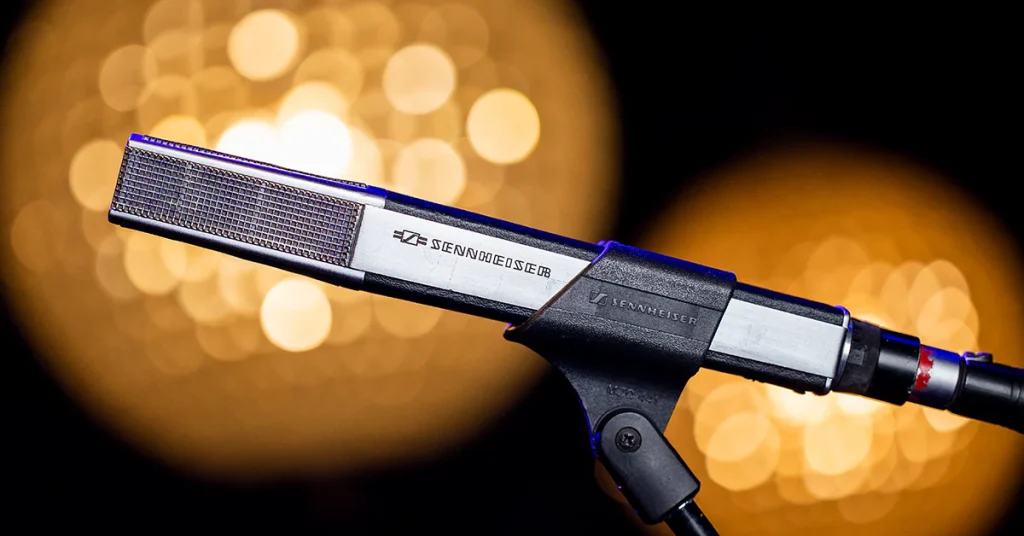
There will never be one mic to rule them all.
That being said, if you’re after a really exceptional dynamic microphone that has tonal characteristics of a condenser, look no further!
Despite its space-age aesthetic, it works on an amazing number of sources. Loud or soft vocalists, acoustic guitars, toms, guitar cabinets, the versatility sheen and isolation this microphone offers is very valuable indeed.
Whilst no longer particularly used on broadcast applications , it’s near-perfect super-cardioid pattern and in-built pop-filter, switchable high frequency boost and low frequency roll-off have proved an enduring favourite in recording studios since the 70s.

At Arcus Sounds, every microphone, and the rest of our recording equipment, has unique role to play in live session excellence. There’s more to come in this series, but to really get into the detail of how to get the most of our little East London Recording Studio, get in touch!